Raloxifene
Modulateur sélectif des récepteurs œstrogéniques pour la prévention et l'inversion de la gynécomastie. Cible les récepteurs du tissu mammaire sans effondrer les œstrogènes.
Composé
En un coup d'œil
En un coup d'œil
- Concentration
- 50 × 60mg
- Pureté
- Équivalent USP ≥98 %
- Voie
- Orale
- Conservation
- À température ambiante, au sec, à l'abri de la lumière.
Raloxifene Hydrochloride is a second-generation selective estrogen receptor modulator (SERM) developed by Eli Lilly and approved by the FDA in 1997 under the brand name Evista for osteoporosis prevention and treatment in postmenopausal women, and subsequently for invasive breast cancer risk reduction. In anabolic research, Raloxifene has emerged as the SERM of choice for gynecomastia prevention and reversal — a role in which it demonstrates superior tissue selectivity compared to Tamoxifen.
Raloxifene's mechanism involves high-affinity binding to estrogen receptors alpha (ERα) and beta (ERβ), with tissue-specific agonist/antagonist effects determined by cofactor recruitment patterns unique to each tissue type. In breast tissue, Raloxifene acts as a potent estrogen antagonist — it blocks estradiol from activating the transcription of estrogen-responsive genes responsible for glandular proliferation. This is the mechanism by which it prevents and can reverse gynecomastia. In bone, it acts as an estrogen agonist, supporting bone mineral density. In hepatic tissue, it has a neutral-to-favorable effect on lipid profiles, though less so than Tamoxifen. Critically, Raloxifene does not significantly stimulate uterine tissue — a key differentiator from Tamoxifen, which carries a small but documented risk of endometrial complications in clinical use.
Raloxifene's primary advantage over Tamoxifen in anabolic research is its superior selectivity for breast tissue estrogen receptors. Clinical trials directly comparing the two SERMs in breast cancer prevention found Raloxifene to be equally effective at reducing invasive breast cancer incidence while carrying fewer adverse effects. In practical terms, researchers report that Raloxifene is more effective than Tamoxifen at reducing existing gynecomastia nodules — particularly when the tissue is fibrous/chronic rather than acute/inflammatory. It achieves this without stimulating the HPTA as aggressively as Tamoxifen, which makes it less suitable as a standalone PCT compound but more suitable as a targeted anti-gyno agent.
Raloxifene is appropriate for researchers at all experience levels who need targeted gynecomastia management. It is the first-line SERM for researchers with existing gynecomastia who want to attempt pharmacological reversal before considering surgical intervention. It is also appropriate as a preventive agent during cycles involving aromatizing compounds, either alongside an AI or as a standalone breast-tissue protective measure. It is not optimal for PCT (Nolvadex and Clomid remain superior for HPTA recovery).
Raloxifene has a half-life of approximately 27.7 hours, supporting once-daily dosing. For active gynecomastia reversal, research dosages of 60 mg daily for 3–6 months have demonstrated significant reduction in breast tissue volume in clinical literature. For preventive on-cycle use, 30–60 mg daily is typical. Raloxifene is not hepatotoxic and does not require liver-support supplementation. It does not interact with aromatase inhibitors (unlike Tamoxifen, which reduces Exemestane efficacy), making it a more flexible SERM to include in complex stacks. The primary reported side effect is mild leg cramping, typically dose-dependent and transient.
---
*Generated 2026-05-25 for Novo Pharma flagship (site-c). Products #11 and #14 consolidated as duplicate Clenbuterol entries — 17 unique compound descriptions covering 18 SKUs.* # Novo Pharma — SARMs & Research Compounds: Product Detail Page Descriptions
Dose ranges published in the peptide-research literature vary considerably. Research protocols should be designed by a qualified researcher and use the lowest effective dose consistent with the hypothesis being tested. Half-life determines dosing frequency — shorter half-lives usually require daily dosing, while long-acting analogues tolerate weekly administration.
For compound-specific dose theory, see the half-life dosing math guide and the stacking theory reference.
Vérification indépendante en laboratoire
Avis de recherche
Pour usage de recherche et de laboratoire uniquement. Non destiné à la consommation humaine ou vétérinaire. Novo Pharma vend à des chercheurs qualifiés majeurs et expédie uniquement aux adresses canadiennes. Voir avis de non-responsabilité et conditions.
Lire la recherche
Articles de référence du laboratoire qui examinent ce composé.
Composés similaires.
Voir tous les Oraux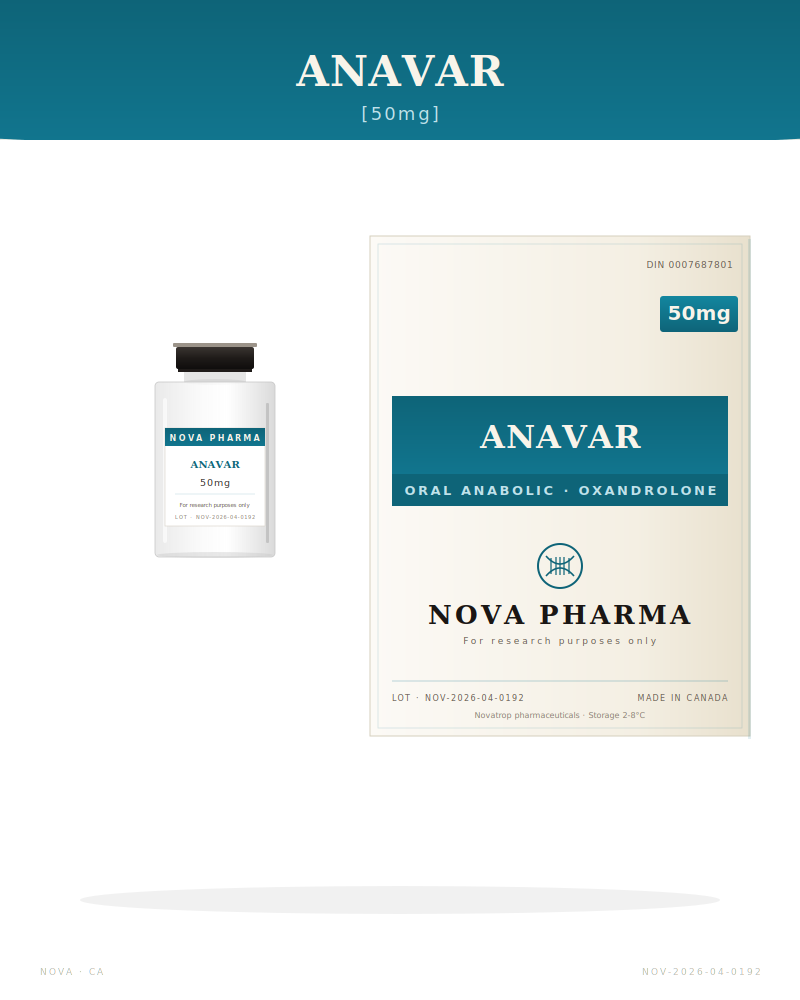
Anavar
50 × 20mg
Achetez 3+ : 15 % de rabais
Anadrol
100 × 25mg
Achetez 3+ : 15 % de rabais
Winstrol
50 × 25mg
Achetez 3+ : 15 % de rabais
Turinabol
50 × 25mg
Achetez 3+ : 15 % de rabais