Oxytocin
The 'bonding hormone' peptide. Research applications in social behavior, stress reduction, and recovery.
Compound
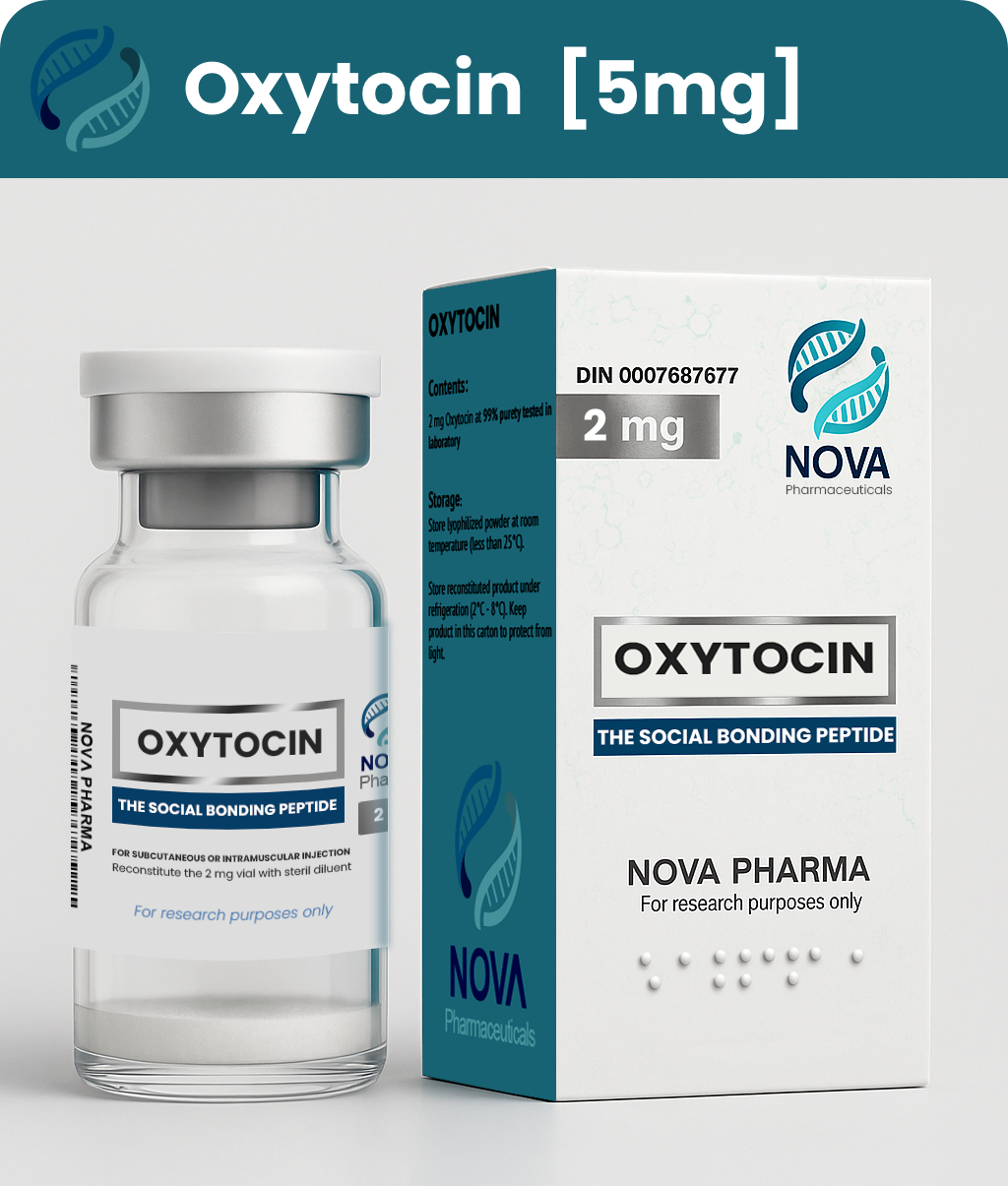
At a glance
At a glance
- Concentration
- 5mg
- Purity
- 99.5%+
- Route
- Subcutaneous injection
- Storage
- Lyophilized: room temperature, desiccated. Reconstituted: 2–8°C, ≤30 days.
Oxytocin is a naturally occurring nonapeptide hormone (Cys-Tyr-Ile-Gln-Asn-Cys-Pro-Leu-Gly-NH2) with a disulfide bridge between the two cysteine residues. It is synthesized in the magnocellular neurons of the hypothalamic paraventricular and supraoptic nuclei and released from the posterior pituitary. While historically known for its role in labor, lactation, and maternal bonding, the past two decades of research have revealed oxytocin as a far broader neuromodulator with effects on social cognition, stress response, pain perception, inflammation, wound healing, and metabolic regulation.
Oxytocin acts through the oxytocin receptor (OXTR), a G-protein-coupled receptor expressed in the brain (amygdala, hippocampus, hypothalamus, nucleus accumbens), heart, uterus, gastrointestinal tract, adipose tissue, and immune cells. In the CNS, oxytocin modulates the amygdala's threat-detection circuitry, reducing fear-conditioned responses, social anxiety, and stress reactivity. It enhances social cognition — the ability to read facial expressions, infer emotional states, and calibrate social behavior — and promotes prosocial behaviors including trust, generosity, and pair bonding. Peripherally, oxytocin has anti-inflammatory effects (reducing TNF-alpha, IL-6, and CRP), analgesic properties (modulating pain perception through interaction with opioid pathways), and emerging metabolic effects including appetite modulation and improved glucose homeostasis.
Research on exogenous oxytocin administration spans social neuroscience, stress physiology, pain management, wound healing, and metabolic regulation. Studies document reductions in cortisol and subjective stress measures, improvements in social interaction quality and empathic accuracy, analgesic effects in chronic pain conditions, accelerated wound healing rates, and beneficial effects on body composition when combined with caloric restriction. The compound's effects on stress-mediated recovery impairment — where chronic stress hormones delay healing and reduce immune function — position it as a compound that may enhance recovery through psychoneuroimmunological mechanisms.
Oxytocin is suited for researchers investigating social neuroscience, stress physiology, psychoneuroimmunology, pain modulation, and the interaction between psychological state and physical recovery. It represents a unique class of compound that bridges behavioral neuroscience and physiological recovery.
Reconstitute the 5mg vial with 1-2ml bacteriostatic water. Oxytocin is most commonly administered intranasally in research settings, at doses of 20-40IU (approximately 40-80mcg) per administration. Intranasal delivery provides rapid CNS access bypassing the blood-brain barrier. Subcutaneous injection is an alternative route for peripheral (anti-inflammatory, wound healing) research applications. Oxytocin has a short half-life of approximately 3-5 minutes in plasma, but its receptor-mediated effects (particularly the stress-reducing and prosocial effects) persist for 1-3 hours post-administration. Store at 2-8C after reconstitution. Oxytocin is sensitive to heat and should not be exposed to temperatures above 25C.
---
## Immune & Sleep
Oxytocin is supplied as a lyophilized (freeze-dried) powder and must be reconstituted with bacteriostatic water (BAC water) before use in a research setting.
- Clean the BAC water vial stopper and the peptide vial stopper with an alcohol swab. Allow to dry.
- Draw the required volume of BAC water into a sterile syringe (typically 1–3 mL depending on target concentration).
- Angle the needle so the water runs down the inside wall of the peptide vial. Avoid dispensing directly onto the powder.
- Do not shake. Gently swirl or roll until fully dissolved. Vigorous shaking can denature peptides.
- Refrigerate reconstituted solution at 2–8°C. Most reconstituted peptides are stable 14–30 days depending on compound.
Target concentration determines drawing volume. For dosing math, consult the dosing math guide.
Independent lab verification
Research disclaimer
For research and laboratory use only. Not for human or veterinary consumption. Novo Pharma sells to qualified researchers of legal age and ships to Canadian addresses only. See disclaimer and terms.
Read the research
Reference articles from the lab covering this compound.
best of
Best Peptides for Gut Health 2026: IBS, Leaky Gut & IBD Research
Discover the best peptides for gut health in 2026. Research-backed protocols for IBS, leaky gut, IBD, and Crohn's using BPC-157 oral, KPV, LL-37, VIP, and Oxytocin.
compound guides
Oxytocin Peptide: Beyond the 'Love Hormone' — Research Applications
Oxytocin is far more than the "bonding hormone." This 9-amino acid peptide shows research applications in social anxiety, PTSD, chronic pain, wound healing, metabolism, and addiction. Learn intranasal dosing and mechanisms.
dosage and cycles
Nasal Peptide Sprays: Administration Technique for Selank, Semax, and PT-141
How nasal peptide sprays are formulated, dosed, and administered — technique, bioavailability, and which compounds work intranasally.