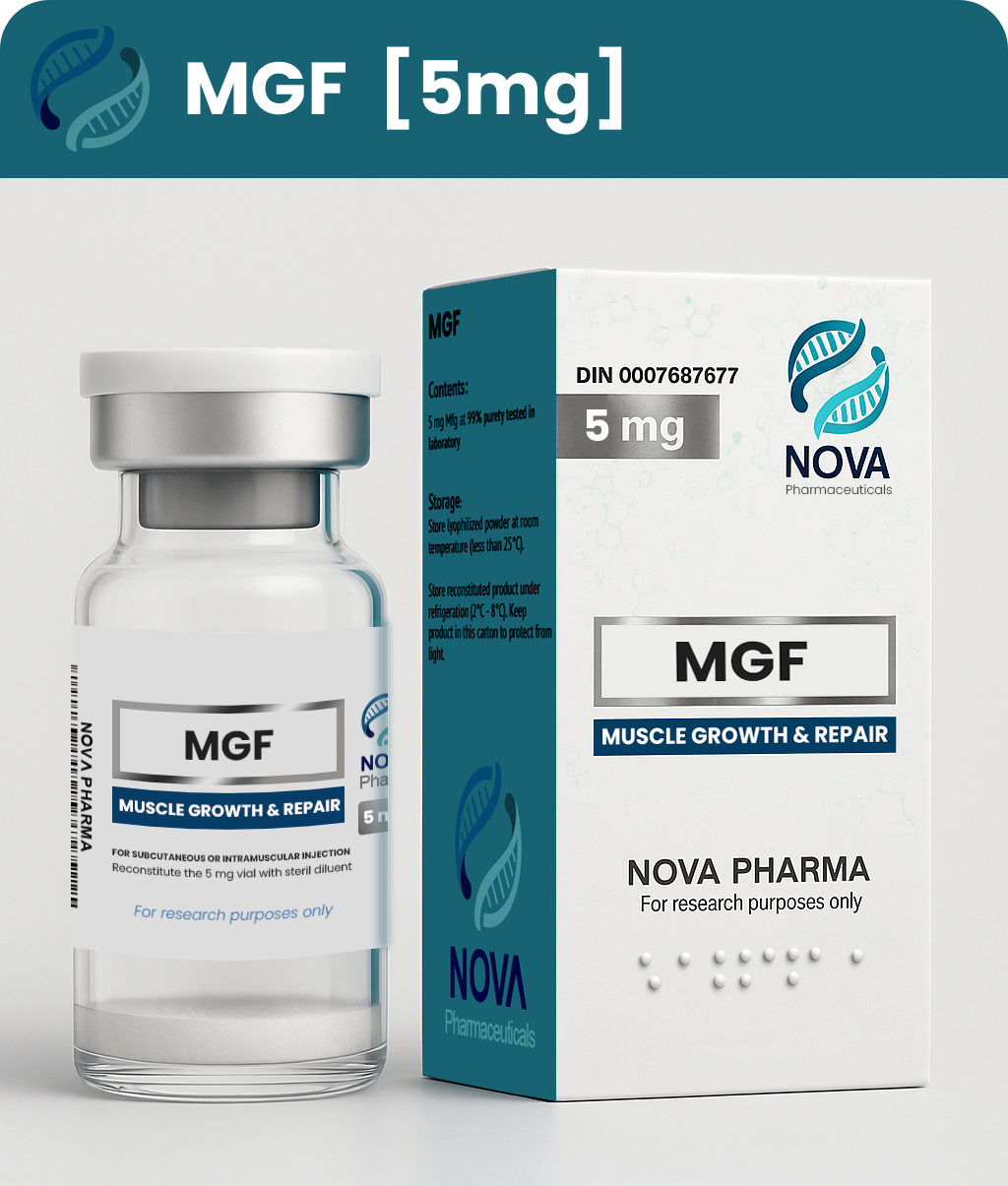
MGF
Mechano Growth Factor — splice variant of IGF-1. Activates satellite cells for muscle repair after intense training.
Compound
At a glance
At a glance
- Concentration
- 5mg
- Purity
- 99.5%+
- Route
- Subcutaneous injection
- Storage
- Lyophilized: room temperature, desiccated. Reconstituted: 2–8°C, ≤30 days.
MGF (Mechano Growth Factor) is a splice variant of IGF-1 that is produced locally in muscle tissue in response to mechanical stress — specifically, the eccentric loading and micro-damage that occurs during resistance training. The full name is IGF-1Ec (in humans), representing a unique C-terminal peptide sequence generated by alternative splicing of exon 5 and 6 of the IGF-1 gene. While systemic IGF-1 drives general anabolic signaling, MGF acts as a local, autocrine/paracrine signal that specifically activates muscle satellite cells — the resident stem cells responsible for muscle fiber repair and regeneration.
MGF's mechanism of action centers on satellite cell activation. Under normal conditions, satellite cells exist in a quiescent state beneath the basal lamina of muscle fibers. When muscle damage occurs, MGF is one of the first signals produced locally to activate these dormant cells, causing them to proliferate (expand the pool of repair cells) and subsequently differentiate into myonuclei that fuse with damaged fibers. MGF achieves this through IGF-1 receptor-independent signaling — its unique C-terminal E-domain peptide binds to receptors distinct from the classical IGF-1R, making its satellite cell activation complementary to rather than redundant with IGF-1 LR3. Researchers have documented that MGF's proliferative signal precedes the differentiation signal from mature IGF-1 splice variants, establishing it as the initial trigger in the muscle repair cascade.
The research literature documents MGF's effects on satellite cell proliferation, muscle repair acceleration, and local tissue regeneration. Studies using electrotransfer and direct injection models show significant increases in muscle fiber cross-sectional area and satellite cell marker expression. MGF has also shown effects in cardiac tissue repair, neuronal protection, and bone healing, suggesting its satellite cell activation mechanism is not muscle-exclusive.
MGF is suited for researchers investigating satellite cell biology, post-exercise muscle repair, local tissue regeneration, and the IGF-1 splice variant signaling hierarchy. It is commonly used in sequence with IGF-1 LR3: MGF administered immediately post-training for satellite cell activation, followed by IGF-1 LR3 to support the subsequent differentiation and maturation phase.
Reconstitute with 1-2ml bacteriostatic water. Administer via intramuscular injection directly into the target muscle group, ideally immediately post-training when local MGF production is naturally elevated. Standard MGF (non-PEGylated) has a very short half-life of approximately 5-7 minutes due to rapid enzymatic degradation, making timing and injection site critical. Typical research dosing is 100-200mcg per target muscle, administered bilaterally. Store at 2-8C after reconstitution. Due to the extremely short half-life, some researchers prefer the PEGylated version (PEG-MGF) for systemic protocols.
MGF is supplied as a lyophilized (freeze-dried) powder and must be reconstituted with bacteriostatic water (BAC water) before use in a research setting.
- Clean the BAC water vial stopper and the peptide vial stopper with an alcohol swab. Allow to dry.
- Draw the required volume of BAC water into a sterile syringe (typically 1–3 mL depending on target concentration).
- Angle the needle so the water runs down the inside wall of the peptide vial. Avoid dispensing directly onto the powder.
- Do not shake. Gently swirl or roll until fully dissolved. Vigorous shaking can denature peptides.
- Refrigerate reconstituted solution at 2–8°C. Most reconstituted peptides are stable 14–30 days depending on compound.
Target concentration determines drawing volume. For dosing math, consult the dosing math guide.
Independent lab verification
Research disclaimer
For research and laboratory use only. Not for human or veterinary consumption. Novo Pharma sells to qualified researchers of legal age and ships to Canadian addresses only. See disclaimer and terms.
Read the research
Reference articles from the lab covering this compound.
comparisons
MGF vs PEG-MGF vs IGF-1 LR3: Growth Factor Peptide Showdown
Compare MGF, PEG-MGF, and IGF-1 LR3 — three growth factor peptides with distinct applications for muscle growth. Learn when to use localized MGF for lagging body parts, systemic PEG-MGF for recovery, and IGF-1 LR3 for overall hyperplasia. Dosing, protocols, and stacking for Canadian users.
compound guides
IGF-1 LR3 — A Complete Research Reference
Long-R3 IGF-1: structure, IGFBP-evasion design, MAPK/PI3K-Akt signaling, the rodent and cell-culture literature, and the unresolved hyperplasia-versus-hypertrophy question.