IGF-1 LR3
Long-acting Insulin-like Growth Factor. Promotes hyperplasia — actual new muscle cell creation, not just hypertrophy.
Compound
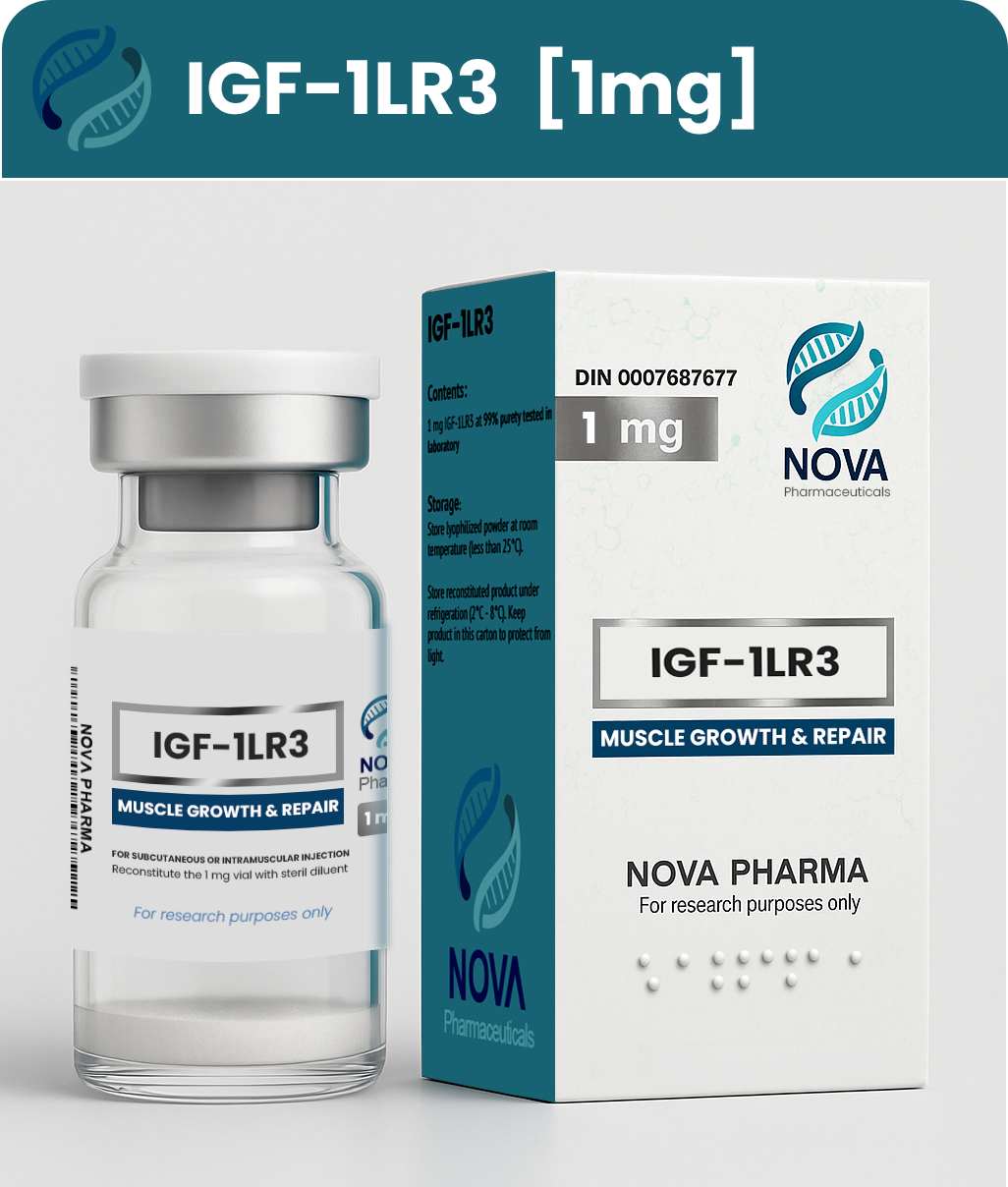
At a glance
At a glance
- Concentration
- 1mg
- Purity
- 99.5%+
- Route
- Subcutaneous injection
- Storage
- Lyophilized: room temperature, desiccated. Reconstituted: 2–8°C, ≤30 days.
IGF-1 LR3 (Long R3 Insulin-like Growth Factor-1) is a modified 83-amino-acid analog of human IGF-1. The native IGF-1 molecule (70 amino acids) is the primary downstream mediator of growth hormone's anabolic effects, but its utility as a research compound is limited by its extremely short half-life (12-15 minutes) due to rapid binding by six IGF-binding proteins (IGFBPs). IGF-1 LR3 addresses this limitation through two modifications: an arginine substitution at position 3 (replacing glutamic acid) and a 13-amino-acid N-terminal extension peptide. These changes reduce IGFBP binding affinity by over 100-fold, extending the effective half-life to approximately 20-30 hours and dramatically increasing the fraction of free, bioactive IGF-1 in circulation.
IGF-1 LR3 activates the IGF-1 receptor (IGF-1R), a transmembrane tyrosine kinase receptor that signals through the PI3K-Akt and Ras-MAPK pathways. These are the primary intracellular cascades governing cell proliferation, differentiation, and survival. The critical distinction between IGF-1 LR3 and GH-releasing peptides is the difference between hypertrophy and hyperplasia. GH and standard IGF-1 primarily promote hypertrophy — the enlargement of existing cells. IGF-1 LR3, at sufficient concentrations, can promote hyperplasia — the division and creation of entirely new cells, including satellite cell proliferation in skeletal muscle tissue. This means IGF-1 LR3 has the theoretical capacity to increase the total number of muscle fibers, not merely their size.
Research documents IGF-1 LR3's potent anabolic, anti-catabolic, and cell-proliferative effects. Studies demonstrate enhanced protein synthesis, reduced protein degradation, increased satellite cell activation and differentiation, accelerated recovery from muscle damage, and improved nitrogen retention. The compound also demonstrates insulin-mimetic effects — it can lower blood glucose by promoting glucose uptake into muscle and fat tissue — which researchers must account for in protocol design.
IGF-1 LR3 is suited for advanced researchers investigating muscle hyperplasia, satellite cell biology, anabolic signaling beyond the GH axis, and recovery optimization. It is not a beginner compound — its potent metabolic effects (particularly hypoglycemia risk) and non-GH-axis mechanism require experienced protocol design.
Reconstitute the 1mg vial with 1ml bacteriostatic water (yielding 1mg/ml or 1000mcg/ml). Administer via subcutaneous or intramuscular injection, typically 20-50mcg per day. Due to its insulin-mimetic properties, administer with or shortly after a meal containing carbohydrates to mitigate hypoglycemia risk. The 20-30 hour half-life supports once-daily dosing. Protocols typically run 4-6 weeks on, 4 weeks off to prevent receptor downregulation. Store at 2-8C after reconstitution, -20C for long-term lyophilized storage. IGF-1 LR3 is sensitive to agitation — do not shake the vial.
IGF-1 LR3 is supplied as a lyophilized (freeze-dried) powder and must be reconstituted with bacteriostatic water (BAC water) before use in a research setting.
- Clean the BAC water vial stopper and the peptide vial stopper with an alcohol swab. Allow to dry.
- Draw the required volume of BAC water into a sterile syringe (typically 1–3 mL depending on target concentration).
- Angle the needle so the water runs down the inside wall of the peptide vial. Avoid dispensing directly onto the powder.
- Do not shake. Gently swirl or roll until fully dissolved. Vigorous shaking can denature peptides.
- Refrigerate reconstituted solution at 2–8°C. Most reconstituted peptides are stable 14–30 days depending on compound.
Target concentration determines drawing volume. For dosing math, consult the dosing math guide.
Independent lab verification
Research disclaimer
For research and laboratory use only. Not for human or veterinary consumption. Novo Pharma sells to qualified researchers of legal age and ships to Canadian addresses only. See disclaimer and terms.
Read the research
Reference articles from the lab covering this compound.
best of
Best Peptides for Muscle Growth 2026: From GH Secretagogues to Growth Factors
Best peptides for muscle growth in 2026 ranked by mechanism: GH secretagogues, growth factors, and myostatin inhibitors. Protocols for natural lifters, bodybuilders on AAS, and injury-plagued athletes.
comparisons
MGF vs PEG-MGF vs IGF-1 LR3: Growth Factor Peptide Showdown
Compare MGF, PEG-MGF, and IGF-1 LR3 — three growth factor peptides with distinct applications for muscle growth. Learn when to use localized MGF for lagging body parts, systemic PEG-MGF for recovery, and IGF-1 LR3 for overall hyperplasia. Dosing, protocols, and stacking for Canadian users.
compound guides
IGF-1 LR3: The Extended Half-Life Growth Factor for Muscle Growth
IGF-1 LR3 is a modified insulin-like growth factor with a 20-30 hour half-life that promotes muscle hyperplasia (new muscle cells). Learn dosing (20-60mcg/day), injection protocols, hypoglycemia management, and how it compares to HGH for muscle growth in Canada.